Tag Archives: accessible
Moving Sawteeth
As the moving ramp waveforms move back and forth they appear to change in brightness. As they move to the right, the upper field seems to brighten (and look slightly yellow) and the lower field seems to dim (and look slightly blue). A fixed retinal receptor viewing the upper half will see continuous brightening ramps punctuated by sudden drops. Probably, visual nonlinearities reduced the effectiveness of the sudden drops, so the ramping brightness predominates. (Cavanagh & Anstis, Vision Research 1986)
When the stripes move steadily to the right, the upper field looks apparently brighter. Adapt for ~20s, then click the Pause button. You will see a leftward motion aftereffect, plus a ‘ramp aftereffect’ of apparent dimming in the upper half and apparent brightening in the lower half.
Blurred disc vs. Edges
A flickering contour is a much more effective adaptor than a flickering blurred surface. Gaze at the center spot and view the flickering adapting stimuli, on the left a ring and on the right a blurred surface. Following adaptation, the left test disk disappears while the right disk remains visible. Adapting to the flickering contour leads to contour erasure, while adaptating to the surface does not.
Half Moon Illusion
Incomplete contour erasure can affect the perceived brightness of a uniformly filled light grey disk. First adapt to the flicker of the semicircle, presented superimposed on the left edge of the disk. Following flicker adaptation, not only has the left edge of the disk disappeared, but also a brightness gradient is apparent, making the disk appear like a half moon. In the absence of edge information on the left half of the disk, the brain appears to interpolate the brightness levels from the unadapted right edge to the background level.
Rotating Rings with Patrick Cavanagh

The texture filling the rings is either stationary (rings seem to move slowly) or moves in the opposite directions to the rings (rings slide over each other, each spinning CCW as the pair turn CW) or in the same direction as the rings (rings appear to move very fast as a rigid
The rings appear to slide over one another when the intersections are dark so that they obey Metelli’s transparency rules. They lock together into a rigid trefoil when the intersections are light and look opaque…..
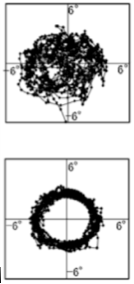
Eye-movement tracked while watching the stimuli. (top representing right rings, bottom representing left)
Left-hand rotating rings with painted-on spots were parsed as a solid figure of eight. Observers could easily track rigid intersection (lower right graph) (Anstis & Ito, Perception 2011).
Right-hand rotating rings with vertically aligned gaps or spots appeared to slide. Observers could not track sliding intersection where rings cross. Upper right-hand graph shows the noisy pattern of eye movements.
No flies on Rama: The flying bugs illusion
These two bugs fly clockwise along circular orbits of the same size, in all 3 movies. They are in counter phase; one is at 6 o’clock when the other is at 12 o’clock.
Now the right orbit looks twice as big as the left orbit, because the clockwise moving background is in phase with the left-hand orbit but in counter-phase with the right-hand orbit, which it enhances.
The orbits look elliptical, wide on the left and tall on the right.The background moves counter-clockwise and is in counter-phase with the horizontal components of the left fly but the vertical components of the right fly.
Flash-Grab
With PATRICK CAVANAGH
Motion undershoot. Bar rotates through 180°, from 12 to 12 o’clock. But it appears to move only from 1 to 11 o’clock.
Same as the ring but for linear motion. Red and green bars are in the same position but appear to be offset. Try tracking them with your eyes; your eyes feel as if they move, but they really don’t!!
Same idea here! Right-angled cross looks wonky because moving sector edges shift the cross arms more than moving middles of sectors.
Chopsticks Illusion
Similarly, the two black ring stimuli are the same except for the small white gaps. Left: When the gaps float, always lying at ‘6 & 12 o’clock’, one perceives two rings circling each other. Right: When the gaps rotate with the rings, one perceives a single rotating figure-8. So local gaps control the global percept.
On the left: Try to track the central intersection of the chopsticks, or the X-junction where the rings intersect. You cannot! So pursuit eye movements are not simple dumb clockwork servos, but are controlled by top-down object parsing.
 Below: HIRO ITO recorded eye movements tracking the chopstick stimulus with and without a surrounding frame.