Category Archives: Illusions
Moving Sawteeth
As the moving ramp waveforms move back and forth they appear to change in brightness. As they move to the right, the upper field seems to brighten (and look slightly yellow) and the lower field seems to dim (and look slightly blue). A fixed retinal receptor viewing the upper half will see continuous brightening ramps punctuated by sudden drops. Probably, visual nonlinearities reduced the effectiveness of the sudden drops, so the ramping brightness predominates. (Cavanagh & Anstis, Vision Research 1986)
When the stripes move steadily to the right, the upper field looks apparently brighter. Adapt for ~20s, then click the Pause button. You will see a leftward motion aftereffect, plus a ‘ramp aftereffect’ of apparent dimming in the upper half and apparent brightening in the lower half.
Blurred disc vs. Edges
A flickering contour is a much more effective adaptor than a flickering blurred surface. Gaze at the center spot and view the flickering adapting stimuli, on the left a ring and on the right a blurred surface. Following adaptation, the left test disk disappears while the right disk remains visible. Adapting to the flickering contour leads to contour erasure, while adaptating to the surface does not.
Half Moon Illusion
Incomplete contour erasure can affect the perceived brightness of a uniformly filled light grey disk. First adapt to the flicker of the semicircle, presented superimposed on the left edge of the disk. Following flicker adaptation, not only has the left edge of the disk disappeared, but also a brightness gradient is apparent, making the disk appear like a half moon. In the absence of edge information on the left half of the disk, the brain appears to interpolate the brightness levels from the unadapted right edge to the background level.
Footsteps
Journal of Illusion · Vol. 2 · 2021 · Article 5612 · Review Report
A review of the footsteps illusion
Abstract
Studies on the footsteps illusion proposed by Anstis (2001) and its variants are reviewed in this article. The footsteps illusion has been explained as a difference in perceived speed depending on edge contrast (Thompson, 1982). In addition to this explanation, it is suggested that the footsteps illusion and its variants can also be attributed to the geometrical illusion presented by Gregory and Heard (1983), to the extinction effect similar to hidden images by Wade (1990), and to subsequent position or motion captures. Related illusions, for example, the kickback illusion (Howe, Thompson, Anstis, Sagreiya, & Livingstone, 2006), the kick-forward illusion, the driving-on-a-bumpy-road illusion, or the footsteps illusion based upon reverse phi motion, are discussed in this article.
Keywords: footsteps illusion · motion perception · contrast · geometrical illusion · extinction effect · position capture · motion capture · reverse phi
Introduction
Motion perception is an intriguing subject that has been fascinating vision researchers and artists. It is not simply the perception of a set of different still images that are arranged along a time axis. For example, a motion aftereffect is observed when observers watch a stationary image after seeing a moving object (Anstis, Verstraten, & Mather, 1998). There are several instances of motion illusion in a still image without prior adaptation to motion (Kitaoka, 2014, 2017; Kitaoka & Ashida, 2007; Pinna & Brelstaff, 2001; Spillmann, Saito, & Komatsu, 2016). A change in luminance alone can cause motion perception (Anstis, 1970; Gregory & Heard, 1983; Rogers, Anstis, Ashida, & Kitaoka, 2019).
Although there are a variety of topics in motion perception, the footsteps illusion (Anstis, 2001, 2003, 2004) is particularly intriguing because the object’s motion becomes dramatically faster or slower depending on the background. The study of this illusion is expected to help to clarify the mechanism of motion perception. To achieve this goal, we here review the footsteps illusion, its abundant variants, and new related illusions.
The footsteps illusion
The footsteps illusion is a motion illusion in which objects appear to move fast or slow even when they move at a constant speed. For example, when blue or yellow rectangles move horizontally at a constant speed across a stationary grating of vertical black and white stripes, they appear to accelerate or decelerate repeatedly (moving or pausing) like a footstep motion (Movie 1). Each rectangle has the same width as two stripes, so that its leading and trailing edges always lie on the same color (black or white). The rectangles appear to slow down when their moving edges are of lower contrast (blue vs. black; yellow vs. white). Color is not indispensable, and achromatic (dark-gray or light-gray) rectangles instead of the chromatic ones work (Movie 2). The footsteps illusion is also observed when rectangles are black or white and the stripes are dark-gray or light-gray (Movie 3). It is therefore suggested that the essential factor is the luminance contrast of moving edges.
When the rectangles have the same width as three stripes, so that their leading and trailing edges always lie on the different color (black vs. white), the ‘inchworm’ variant of the footsteps illusion is observed (Anstis, 2001) (Movie 4). The rectangles appear to repeatedly expand and contract horizontally. This illusion indicates that the leading and trailing edges independently contribute to the footsteps illusion.
The inverted footsteps illusion
Even when rectangles are stationary and the grating moves, the former appear to move like the footsteps illusion (Movie 5). This illusion was presented by Howe et al. (2006) as their Stimulus 2d demo. Since the rectangles are stationary, this footstep motion is an induced motion. Hereafter, we call this phenomenon as the ‘inverted footsteps illusion’.
Anstis (2004) attributed the footsteps illusion to the difference in perceived speed that depends on the difference in luminance contrast. This hypothesis is based upon the observation that gratings of lower contrast appear to move slower than those of higher contrast (Stone & Thompson, 1992; Thompson, 1982).
This hypothesis was criticized by Howe et al. (2006), who reported a much weaker footstep appearance when the target moved on a homogeneous background alternating between black and white. This hypothesis cannot be applied to the inverted footsteps illusion, either, because the target is stationary. Yet, it should be stressed that the footsteps illusion based upon the difference in apparent speed depending on edge contrast is observed to some extent (Anstis, 2003) (Movie 6).
Involvement of position capture and motion capture
Here we demonstrate that the footsteps illusion and the inverted one can be observed well even at a low speed. Movie 7 shows the footsteps illusion at a low speed. When moving edges are of low contrast, the motion appears to slow down or to be captured there. The latter is typically referred to as ‘position capture’ (Murakami & Shimojo, 1993), and the rectangles seem to lie alternately closer together and further apart.
Movie 8 shows the inverted footsteps illusion at a low speed. When the edges of a rectangle are of low contrast, the rectangle appears to be captured by the moving grating and appears to move with it. This phenomenon is typically referred to as ‘motion capture’, although this term usually indicates the phenomenon that a stationary object contoured by color edges (e.g. red vs. green) of low luminance contrast appears to move, being induced by the surround that moves (Goda & Ejima, 1997; Ramachandran, 1987).
In addition, when the edges of a rectangle are of high contrast in Movie 8, the rectangle seems to undergo induced movement, seeming to move in a direction opposite to the stripe. This may be a partial cause of the inverted footsteps illusion.
Involvement of the geometrical illusion
Thompson and Anstis (2005) suggested a contribution of the geometrical illusion, presenting the Wenceslas illusion. Figure 1 shows an instance, in which multiple squares appear to be placed in an undulating manner although they are aligned in a straight line. This geometrical illusion or position illusion corresponds to the ‘belly dancer illusion’ that Howe et al. (2006) demonstrated as its moving counterpart (Movie 9).

Subsequently, Sunaga, Sato, Arikado, and Jomoto (2008) claimed that the footsteps illusion is an outcome of a geometrical illusion. Figure 2 demonstrates illusory positional shifts of rectangles. In Fig. 2a, the spacing between the upper two blue rectangles appears to be shorter than the spacing between the lower two yellow rectangles, although they are the same distance apart. On the other hand, in Fig. 2b, the reverse is observed. When a dark object (blue rectangle) is connected to a thin dark object (black stripe), the connected edge appears to shift toward the latter. When a light object (yellow rectangle) is connected to a thin light object (white stripe), the connected edge appears to shift toward the latter. This geometrical-illusion hypothesis can be applied to the inverted footsteps illusion too.

We think that this geometrical illusion should be credited to Gregory and Heard (1983), although Thompson and Anstis (2005) or Sunaga et al. (2008) did not mention it. This issue is described later. For the inchworm illusion (Movie 4), this positional illusion is converted to a size illusion (Fig. 3).

Explanations that take into account the capture phenomena and the geometrical illusion
Combining the geometrical illusion (Fig. 2) and the motion phenomena (position capture: Movie 7; motion capture: Movie 8), we explain the footsteps illusion and the inverted one as follows. For the footsteps illusion, let us start with a condition like Fig. 4a in which the edges of the rectangles touch those of the stripes. In this condition, the spacing between the upper two rectangles appears to be smaller than that between the lower two rectangles, although they are the same distance apart. When the rectangles move rightward (Fig. 4b), the upper-left rectangle appears to move slowly or stand still, while the upper-right one appears to move as it does. Thus, the upper spacing appears to increase. On the contrary, the lower-left rectangle appears to move as it does while the lower-right one appears to move slowly or stand still. Thus, the lower spacing appears to decrease. When edges of the rectangles touch those of stripes again (Fig. 4c), the upper spacing appears to be larger than the lower one. Finally, when the rectangles move rightward (Fig. 4d), the upper-left rectangle appears to move as it does while the upper-right one appears to move slowly or stand still. Thus, the upper spacing appears to decrease. On the contrary, the lower-left rectangle appears to move slowly or stand still, while the lower-right one appears to move as it does. Thus, the lower spacing appears to decrease. This repetition makes the rectangles appear to move like a footstep.

For the inverted footsteps illusion, let us start with a condition like Fig. 5a in which the edges of rectangles touch those of the stripes. In this condition, the spacing between the upper two rectangles appears to be smaller than that between the lower two rectangles, although they are the same distance apart. When the grating moves rightward behind the rectangles (Fig. 5b), the upper-left rectangle appears to be stationary as it is while the upper-right one appears to be captured by the moving grating and to move rightward. Thus, the upper spacing appears to increase. On the contrary, the lower-left rectangle appears to be captured by the moving grating and to move rightward, while the lower-right one appears to be stationary as it is. Thus, the lower spacing appears to decrease. When edges of the rectangles touch those of stripes again (Fig. 5c), the upper spacing appears to be larger than the lower one. Finally, when the grating moves rightward (Fig. 5d), the upper-left rectangle appears to be captured by the moving grating and to move rightward while the upper-right one appears to be stationary as it is. Thus, the upper spacing appears to decrease. On the contrary, the lower-left rectangle appears to be stationary as it is while the lower-right one appears to be captured by the moving grating and to move rightward. Thus, the upper spacing appears to increase. This repetition makes the rectangles appear to move like a footstep.

Involvement of the extinction effect
There is a possibility that the position capture phenomenon observed in the footsteps illusion (Movie 7) and the motion capture phenomenon found in the inverted footsteps illusion (Movie 8) could be attributed to an extinction effect of edges of low contrast in a special condition. Figure 6a demonstrates that thin line segments of low contrast appear to extinguish rapidly when observers fixate at the cross. When objects are placed on a homogeneous background, they do not appear to extinguish soon (Fig. 6b). It is suggested that the essential factor be a combination between edges of low contrast and edges of high contrast close to the former (Fig. 7). In the chapter entitled ‘Hidden images’, Wade (2017) mentioned that high-contrast, high spatial frequency contours can suppress the visibility of low-contrast, low spatial frequency components within them. This suggestion is consistent with Zenger-Landolt and Koch (2001) who reported that the apparent contrast of an edge is reduced by surrounding edges of high contrast. It is plausible that this extinction effect causes the position capture and motion capture of edges of low contrast in the footsteps illusion and the inverted footsteps illusion, respectively.


Moreover, the footsteps illusion and the inverted one are observed even when blue and yellow rectangles are replaced with black and white ones, respectively (Movies 10 and 11). In this footsteps illusion, position capture occurs when there are no physical motion signals, that is, when the edges of a black rectangle lie inside a black stripe or those of a white rectangle stay inside a white stripe. This variant was presented in Howe et al. (2006), who reported a strong illusion. In the inverted footsteps illusion, motion capture occurs when there are no physical motion signals, which would induce imaginary rectangles to move. It is suggested that the original footsteps illusion (Movie 1) and its inverted one (Movie 5) be attributed to or be equivalent to these variants through the process of the extinction effect.
Other variants of the footsteps illusion
The horizontally elongated variant
The extinction-effect hypothesis may help to explain another footstep phenomenon presented by Howe et al. (2006, their Stimulus 2e demo) (Movie 12). In their stimulus, both rectangles and stripes are elongated horizontally, and the height of each rectangle is the same as that of each stripe. The upper and lower sides of a rectangle touch the lower edge of the upper stripe and the upper edge of the lower stripe, respectively. When one horizontally moves a blue rectangle that is placed on a black stripe and is sandwiched by the upper and lower white stripes (e.g. the upper-right rectangle of Fig. 8: #1), the blue rectangle appears to move behind a yellow rectangle that is placed in the same condition (e.g., the lower-right rectangle of Fig. 8: #2). When one horizontally moves a yellow rectangle that is placed on a white stripe and is flanked by the upper and lower black stripes (e.g., the lower-left rectangle of Fig. 8: #3), the yellow rectangle appears to move behind a blue rectangle that is placed in the same condition (e.g., the upper-left rectangle of Fig. 8: #4). The extinction effect is observed for the rectangles #1 or #3, which appear to be indistinct or sometimes disappear.

This horizontally elongated variant (Movie 12) is not so strong as the original (Movie 1), as pointed out by Howe et al. (2006) who suggested the involvement of an additional mechanism. This suggestion is discounted as follows. One plausible reason is that this variant is not accompanied by the geometrical illusion. Another one is that there is no clue to position capture, although the rectangles #1 and #3 show the extinction effect. It is therefore suggested that the weak footsteps illusion observed in this variant be equivalent to the footsteps illusion based solely upon the difference in apparent speed depending on edge contrast (Anstis, 2003) (Movie 6). Moreover, movies in which the stripes repetitively reverse their polarity over time (such as Movie 12) give rather weak effects, which are generally masked by a strong apparent motion in which the blue and yellow bars appear to jump back and forth.
The enhanced version of the horizontally elongated variant
Movie 13 shows a new version of the horizontally elongated variant, which presents a much stronger footstep motion comparable to the original footsteps illusion (Movie 1). Blocks of horizontally elongated rectangles move horizontally across a stationary checkerboard pattern instead of the alternating stripes (Fig. 9). Moving edges of low contrast (blue vs. black or yellow vs. white) appear to move slower than those of high contrast or to pause there (position capture).

Movie 14 shows its inverted one, in which rectangles are stationary and the checkerboard pattern moves. Stationary lateral edges of low contrast appear to be captured by the moving checkerboard pattern and to move with it (motion capture), while those of high contrast appear to be stationary as they are.
This footsteps illusion or the inverted one is observed even if rectangles or the checkerboard move slowly (Movies 15 and 16). Moreover, the geometrical illusion does not seem to be involved in these variants (Fig. 9). These observations suggest that these horizontally elongated variants chiefly depend on the extinction effect and subsequent capture phenomena in addition to the difference in apparent speed depending on edge contrast.
The railroad-track variant
In the railroad-track variant of the footsteps illusion (Anstis, 2004), rectangles move across a grating of the same height (Movie 17). Although this variant is as strong as the original one, Howe et al. (2006) regarded it as a problem that the illusion is somewhat reduced in comparison to the standard one. We suggest that the reduction, if any, depends on a weaker extinction effect because there is a relatively small amount of edges of high contrast.
Movie 18 shows the clearing-in-a-forest variant (Anstis, 2004), in which little or no footsteps illusion is observed. This observation indicates that the lateral sides of the moving blocks do not contribute significantly to the footsteps illusion.
The color-based variant
Variants of the ‘second-order’ footsteps illusion (Kitaoka & Anstis, 2015) can be explained in the same way. For example, Movie 19 demonstrates the color-based footsteps illusion, in which magenta or cyan rectangles appear to show a footstep motion across a grating of red and green stripes, although this footsteps illusion is rather weak for some observers. Edges of low color contrast (combination of similar colors: magenta vs. red, or cyan vs. green) appear to move slower than edges of high color contrast (combination of nearly opponent colors: magenta vs. green; cyan vs. red) or appear to move slowly or to be captured there (position capture). Movie 20 demonstrates the inverted version, which also shows a footstep appearance. Moreover, the geometrical illusion is observed (Fig. 10), which is also thought to contribute to the color-based footsteps illusion and the inverted one. Although the four colors are selected so as to have similar luminances, it should be noted that there remains a possible involvement of luminance in this variant.

The contrast-modulated variant
Movie 21 shows a footsteps illusion defined by the difference in luminance contrast (Kitaoka & Anstis, 2015). When moving edges of a square have a small difference in contrast, it appears to slow down, as compared to those that have a large difference in contrast. It is suggested that edges with a small difference in contrast might be hard to be detected in visual processing and appear to slow down or to be captured there.
Movie 22 shows its inverted condition, which, however, does not show a footstep motion or display a weak one at best. This finding is unique as compared with the other inverted variants demonstrated so far. It is conjectured because stationary random-dot patterns anchor the squares there. In contrast, the moving squares in the contrast-modulated footsteps illusion (Movie 21) are perceived as transparent layers and are not anchored by random dots.
Moreover, the geometrical illusion is observed (Fig. 11). It is suggested that it also contributes to the contrast-modulated footsteps illusion and the inverted one.

The offset-defined variant
Movie 23 shows a footsteps illusion defined by the difference in offset of abutting gratings (Kitaoka & Anstis, 2015). Blocks contoured by abutting gratings with a small offset appear to move slower than those with a large offset. It is suggested that subjective contours with a small offset might be hard to be detected in visual processing and appear to slow down or to be captured there. Movie 24 shows its inverted variant, which shows a footstep motion. Moreover, the geometrical illusion is observed (Fig. 12) and is thought to contribute to the offset-based footsteps illusion and the inverted one.

The kickback illusion and the kick-forward illusion
Howe et al. (2006) proposed a new motion illusion called the ‘kickback illusion’. Movie 25 shows an instance in which blue rectangles move across a grating made up of white pinstripes on a black background, while yellow rectangles move across a grating of black pinstripes on a white background. The spacing of two adjacent pinstripes is the same as the width of each rectangle. When the edges of a rectangle pass over pinstripes, the rectangle appear to wiggle or jump backward. To be more specific, this effect occurs both when the leading edge covers a pinstripe and when the trailing edge uncovers a pinstripe (Movie 26). Howe et al. (2006) reported that most subjects reported the backward speed to be considerably greater than the forward speed.
Although the kickback illusion is observed even if rectangles move slowly (Movie 27), the geometrical illusion does not seem to be involved in this effect (Fig. 13). Moreover, the extinction effect might take part when the edges move between pinstripes and slow down the rectangles, but it cannot explain the backward motion of the kickback illusion.

Howe et al. (2006) stated that one would expect the footsteps illusion and the kickback illusion to be mediated by the same mechanisms because of their geometric similarity, but that it is probably not the case. They presented two pieces of evidence. One is that the kickback illusion disappears when yellow objects move across white pinstripes on a black background. The other is that the ‘kick-forward’ effect (Movie 28) is observed instead of the kickback one when white objects move across black stripes on a yellow background. The kick-forward illusion also occurs both when the leading edge covers a pinstripe and when the trailing edge uncovers a pinstripe. They suggested that the ‘kick’ part of the kickback illusion is an example of the reverse phi (reversed phi) phenomenon (Anstis, 1970; Anstis & Rogers, 1975, 1986; Rogers et al., 2019).
Movie 28 shows an instance of the kick-forward illusion, in which moving rectangles appear to be accelerated when their edges pass over pinstripes. This illusion gives a strong impression of the footstep motion. The kick-forward effect is observed even if rectangles move slowly (Movie 29) and the geometrical illusion does not seem to be involved in this effect. These observations suggest that the strong impression of the footstep motion be rendered by the alternation between the deceleration caused by the extinction effect when edges move between pinstripes and the acceleration caused by the kick-forward effect when edges pass over pinstripes.
Movies 30 and 31 show the inverted versions of the kickback and kick-forward illusions, respectively. In these cases, illusory motion can be explained in the same manner as those of the kickback or kick-forward illusions.
As Howe et al. (2006) suggested, the ‘kick’ part of the kickback illusion or the kick-forward one cannot be explained in the same manner as the footsteps illusion. Their inverted variants cannot be explained so, either. Although Howe et al. attributed the effect to the reverse phi phenomenon (Anstis, 1970; Anstis & Rogers, 1975, 1986) and we basically agree with them, we here specify the illusion that yields the ‘kick’ part.
Movie 32 shows an instance, in which disks appear to expand or contract when circumference contours appear or disappear. Specifically, a blue disk in the upper-left square appears to expand when its white contour appears, while it appears to contract when the contour disappears. The expansion or contraction is illusory because the blue disk does not change in size. Inversely, a black disk in the upper-right square appears to contract when its white contour appears, while it appears to expand when the contour disappears, although the black disk does not change in size. In the same manner, a yellow disk in the lower-left square appears to expand when its black contour appears, while it appears to contract when the contour disappears. Inversely, a white disk in the lower-right square appears to contract when its black contour appears, while it appears to expand when the contour disappears. This luminance-change-dependent motion illusion was proposed as one of the basic effects underlying the reverse phi motion and other phenomena (Kitaoka, 2006).
In the kickback illusion, when edges of a blue rectangle pass over pinstripes, the leading blue edge hides a white line and the trailing blue edge uncovers another white line (Movie 25). The former corresponds to the disappearance of the white contours shown in Movie 32, while the latter corresponds to the appearance of the white contours. The same is true for the yellow one. The direction of this illusory motion is opposite to that of the moving edges and the backward motion is observed in the kickback illusion.
In the kick-forward illusion, when edges of a black rectangle pass over pinstripes, the leading black edge hides a white line and the trailing black edge uncovers another white line (Movie 28). The former corresponds to the disappearance of the white contours shown in Movie 32, while the latter corresponds to the appearance of the white contours. The same is true for the yellow one. The direction of this illusory motion is the same as that of the moving edges, and the acceleration of motion is observed in the kick-forward illusion.
The driving-on-a-bumpy-road illusion
Movie 33 shows an instance in which blue rectangles move across a grating made up of black pinstripes on a white background, while yellow rectangles move across a grating of white pinstripes on a black background. The spacing of two adjacent pinstripes is the same as the width of each rectangle. When the edges of rectangles pass over pinstripes, the rectangles appear to be captured by the pinstripes, although Howe et al. (2006, their Stimulus 7c demo) reported ‘a percept of almost completely smooth motion’. The whole appearance is something like running a car on a bumpy road. Movie 34 shows the inverted variant, in which stationary rectangles appear to be captured by moving pinstripes and to move with them when pinstripes pass over both edges of a rectangle. Different from the dramatic difference between the kickback illusion and the kick-forward illusion, the appearance does not change even if the colors are exchanged so that rectangles are black or white and pinstripes are blue or yellow (Movies 35 and 36).
It is suggested that the extinction effect occurs when edges pass over pinstripes because they are of low contrast and the position capture or motion capture are followed. Moreover, one may point out a resemblance to the pausing-and-sticking illusion (Goldberg & Pomerantz, 1982), a phenomenon that moving objects appear to pause when they cross each other (Movie 37). Yet, there is a large difference in condition. The pausing-and-sticking illusion is observed when fast moving objects collide, whereas the running-on-a-bumpy-road illusion is observed when moving edges pass over stationary pinstripes. Probably, they are not the same illusion.
The footsteps illusion based upon reverse phi motion
The last one introduced in this article is the footsteps illusion based upon the difference in apparent speed between phi motion and reverse phi motion (Movie 38). Rectangles appear to move fast when they are in phi motion, while they appear to move slowly or move backward when they are in reverse phi motion. Figure 14 shows how to install these phenomena in Movie 38. Phi motion refers to a normal motion perception of an object in which the object appears to move as it does, while reverse phi refers to an illusory motion perception of an object in which the object appears to move in the opposite direction to its positional shift when the contrast polarity of the object is reversed (Anstis, 1970; Anstis & Rogers, 1975, 1986; Rogers et al., 2019). Although this variant resembles the original footsteps illusion in appearance, the mechanisms between them are quite different.

Rating of the footsteps illusion and its variants
To confirm the described phenomenal observations on the footsteps illusion and its variants, the degree of ‘footstep appearance’ in each movie was rated by seven observers. First, each of the observers regarded Movie 1 that shows the standard footsteps illusion as the reference stimulus that should be rated ‘10’. A rating of ‘0’ indicates completely smooth motion. A rating of more than ‘10’ was allowed. Observers rated twenty-seven movies (Movies 1–3, 5, 6, 10–14, 17–25, 28, 30, 31, 33–36, and 38) listed in Table 1. Since this study was conducted in the period of the coronavirus lockdown in 2020, the first author asked observers to rate them on their individual displays. The size of the movie (600 × 480 pixels) shown on each display and the viewing distance were recorded. The results are shown in Fig. 15, which confirms these illusions. Moreover, it was confirmed that the railroad-track variant (Movie 17) is as strong as the footsteps illusion (Anstis, 2004), while the clearing-in-a-forest variant (Movie 18) shows little or no footsteps illusion (Anstis, 2004).

| Movie | Variant | Mean rating |
|---|---|---|
| 1 | Footsteps illusion | 10 |
| 2 | Achromatic footsteps illusion (dark-gray or light-gray rectangles) | 10.7 |
| 3 | Achromatic footsteps illusion (black or white rectangles) | 7.1 |
| 5 | Inverted variant of the footsteps illusion (Movie 1) | 6.7 |
| 6 | Footsteps illusion without fine stripes | 1.2 |
| 10 | Achromatic footsteps illusion (black or white rectangles and stripes) | 11.9 |
| 11 | Inverted variant of the achromatic footsteps illusion (Movie 10) | 9.0 |
| 12 | Horizontally elongated variant | 2.2 |
| 13 | Enhanced version of the horizontally elongated variant | 10.7 |
| 14 | Inverted variant of the enhanced version of the horizontally elongated variant (Movie 13) | 5.9 |
| 17 | Rail-track variant | 8.6 |
| 18 | Clearing-in-a-forest variant | 0.1 |
| 19 | Color-based variant | 3.6 |
| 20 | Inverted variant of the color-based variant (Movie 19) | 3.2 |
| 21 | Contrast-modulated variant | 7.4 |
| 22 | Inverted variant of the contrast-modulated variant (Movie 21) | 0.6 |
| 23 | Offset-based variant | 8.1 |
| 24 | Inverted variant of the offset-based variant (Movie 23) | 5.5 |
| 25 | Kickback illusion | 11.0 |
| 28 | Kick-forward illusion | 7.4 |
| 30 | Inverted variant of the kickback illusion (Movie 25) | 8.8 |
| 31 | Inverted variant of the kick-forward illusion (Movie 28) | 7.5 |
| 33 | Driving-on-a-bumpy-road illusion | 3.1 |
| 34 | Inverted variant of Movie 33 | 2.6 |
| 35 | Another demonstration of the driving-on-a-bumpy-road illusion | 1.5 |
| 36 | Inverted variant of Movie 35 | 1.2 |
| 38 | Footsteps illusion based upon the reverse phi motion | 9.6 |
Note: Movie 1 that shows an instance of the standard footsteps illusion served as the reference rated ‘10’. A rating of ‘0’ was given to the perception of coherent motion as it is. The results are put in the “Mean rating” column.
List of the geometrical illusion involved in the footsteps illusion and its variants
Although the involvement of a geometrical illusion in the footsteps illusion has been pointed out (Sunaga et al., 2008; Thompson & Anstis, 2005), we think this geometrical illusion is a variant of the ‘static displacements’ proposed by Gregory and Heard (1983). Figure 16a consists of four dark rectangles in front of a light-gray background. Each rectangle is flanked by black or white line segment at the lateral sides. This image shows a geometrical illusion that the spacing of the rectangles in the upper row appear to be larger than that of the rectangles in the lower row, although they are aligned vertically. When the gray of rectangles is exchanged with that of the background and black or light flanks are exchanged with each other, the upper spacing appears to be larger than the lower (Fig. 16b). The position of a dark rectangle appears to shift toward its black flank and away from its white one, while the position of a light rectangle appears to shift toward its white flank and away from its dark flank. Figure 16c is a combined image in which the spacing of the upper dark-gray rectangles appears to be larger than that of the lower light-gray ones. Even if, in Fig. 16c, the dark-gray is exchanged with blue and the light-gray is replaced with yellow, the illusion does not change (Fig. 16d). The spacing of the upper blue rectangles appears to be larger than that of the lower yellow ones. The geometrical illusion shown in this figure just corresponds to the illusion shown in Fig. 2a.

Moreover, even if the dark-gray, light-gray, black, and the white in Fig. 16c are exchanged with the magenta, cyan, red, and the green that are adopted in the color-based footsteps illusion (Movie 19), respectively, the illusion does not change. The spacing of the upper magenta rectangles appears to be larger than that of the lower cyan ones (Fig. 16e). The position of a colored rectangle appears to shift toward the flank of the similar color and away from the flank of the different color. The geometrical illusion shown in this figure just corresponds to the illusion shown in Fig. 10a.
Furthermore, even if the black, dark-gray, light-gray, and white in Fig. 16c are exchanged with random-dot patterns of the lowest, second-lowest, second-highest, and highest contrast that are adopted in the contrast-modulated footsteps illusion (Movie 21), respectively, the illusion does not change. The spacing of the upper low-contrast rectangles appears to be larger than that of the lower high-contrast ones (Fig. 16f). The position of a low-contrast rectangle appears to shift toward its lowest-contrast flank and away from its highest-contrast one, while the position of high-contrast rectangle appears to shift toward its highest-contrast flank and away from its lowest-contrast one. The geometrical illusion shown in this figure just corresponds to that in Fig. 11a.
Figure 16g shows the geometrical illusion corresponding to the offset-based footsteps illusion (Movie 23 and Fig. 12a). The position of a rectangle appears to shift toward its flank with a small offset.
We suggest that the geometrical illusion is involved in some but not all examples of the footsteps illusion. For example, the footsteps illusion based upon the difference in apparent speed depending on edge contrast (Anstis, 2003) (Movie 6) or the enhanced version of the horizontally elongated variant (Movie 13 and Fig. 9) do not show the geometrical illusion.
Classification of the footsteps illusion and its variants
This article described the footsteps illusion and its abundant variants. It is thought that the illusions collected in this article are not based on a single mechanism. There are at least three groups in regard to supposed underlying mechanisms (Fig. 17). The first group includes the original footsteps illusion, its variants, and their inverted illusions (Movies 1–24). The second one contains the kickback illusion and kick-forward illusion and their variants (Movies 25–31, 33–36). The third one shows the footsteps illusion based upon reverse phi motion (Movie 38). Moreover, the first group can be classified into subgroups depending on the dimension of edge contrast: luminance-contrast type (Movies 1–18), color-contrast one (Movies 19 and 20), modulated-contrast one (Movies 21 and 22), or offset-contrast one (Movies 23 and 24).

For the first group, it is suggested that the footsteps illusion and its variants be attributed to the geometrical illusion or the extinction effect in addition to the difference in perceived speed depending on edge contrast. This suggestion is consistent with Howe et al. (2006) who attributed the footsteps illusion to the motion signals originating from (1) the moving edges, (2) the lateral edges (the upper and lower edges), and (3) the background edges in the vicinity of the moving edge. It is postulated that the geometrical illusion depends on the combination between (1) and (3), the extinction effect is rendered by the combination between (1) and (2) or between (1) and (3), and the difference in perceived speed depending on edge contrast is solely based upon (1).
For the second group, it is suggested that motion illusion triggered by local luminance changes (Movie 32) (Kitaoka, 2006) should play an important part in acceleration or deceleration of moving rectangles. For the third group, a special combination of reverse phi (Anstis, 1970) and phi motion presents a new demonstration of the footsteps illusion.
Conclusion
A common misconception is that when the mechanism is different, the phenomenon is also necessarily different. Conversely, we tend to think that if the phenomenon is similar, the mechanism is also similar. However, it may well be that the phenomena look similar but have different mechanisms. Therefore, it is important to have a proper understanding of phenomena.
This article collated a variety of illusions to be included in a single category or a single phenomenon called ‘footsteps illusion’, although they are not claimed to be based on a single mechanism. We think that this phenomenal categorization matches the aims of Journal of Illusion that focus on phenomenal aspects of perception. We believe that this review can, in the future, help us better understand how motion perception is achieved.
Acknowledgments
We thank Piers Howe and Hiroyuki Ito for giving helpful comments on this article.
Competing interests and funding: The authors have no conflicts of interest associated with this article. This work was supported by the JSPS KAKENHI Grant (Grants-in-Aid for Scientific Research) Number JP15H01984 awarded to Akiyoshi Kitaoka and a grant from the UCSD Pathways to Retirement awarded to Stuart Anstis.
References
- Anstis, S. M. (1970). Phi movement as a subtraction process. Vision Research, 10, 1411–1430. doi: 10.1016/0042-6989(70)90092-1
- Anstis, S. M. (2001). Footsteps and inchworms: Illusions show that contrast modulates motion salience. Perception, 30, 785–794. doi: 10.1068/p3211
- Anstis, S. M. (2003). Moving objects appear to slow down at low contrasts. Neural Networks, 16, 933–938. doi: 10.1068/p140167
- Anstis, S. M. (2004). Factors affecting footsteps: Contrast can change the apparent speed, amplitude and direction of motion. Vision Research, 44, 2171–2178. doi: 10.1016/j.visres.2004.03.015
- Anstis, S. M., & Rogers, B. J. (1975). Illusory reversal of visual depth and movement during changes of contrast. Vision Research, 15, 957–961. doi: 10.1016/0042-6989(75)90236-9
- Anstis, S. M., & Rogers, B. J. (1986). Illusory continuous motion from oscillating positive–negative patterns: Implications for motion perception. Perception, 15, 627–640. doi: 10.1068/p150627
- Anstis, S., Verstraten, F. A., & Mather, G. (1998). The motion aftereffect. Trends in Cognitive Sciences, 2(3), 111–117. doi: 10.1016/S1364-6613(98)01142-5
- Goda, N., & Ejima, Y. (1997). Moving stimuli define the shape of stationary chromatic patterns. Perception, 26, 1413–1422. doi: 10.1068/p261413
- Goldberg, D. M., & Pomerantz, J. R. (1982). Models of illusory pausing and sticking. Journal of Experimental Psychology: Human Perception and Performance, 8(4), 547–561. doi: 10.1037//0096-1523.8.4.547
- Gregory, R. L., & Heard, P. F. (1983). Visual dissociations of movement, position, and stereo depth. Quarterly Journal of Experimental Psychology, A, 35, 217–237. doi: 10.1080/14640748308402127
- Howe, P. D. L., Thompson, P. G., Anstis, S., Sagreiya, H., & Livingstone, M. S. (2006). Explaining the footsteps, belly dancer, Wenceslas and kickback illusions. Journal of Vision, 6, 1396–1405. doi: 10.1167/6.12.5
- Kitaoka, A. (2006). Configurational coincidence among six phenomena: A comment on van Lier and Csathó (2006). Perception, 35, 799–806. doi: 10.1068/p5319b
- Kitaoka, A. (2014). Color-dependent motion illusions in stationary images and their phenomenal dimorphism. Perception, 43(9), 914–925. doi: 10.1068/p7706
- Kitaoka, A. (2017). The Fraser-Wilcox illusion and its extension. In A. G. Shapiro & D. Todorović (Eds.), The Oxford compendium of visual illusions (pp. 500–511). New York, NY: Oxford University Press. doi: 10.1093/acprof:oso/9780199794607.003.0068
- Kitaoka, A., & Anstis, S. (2015). Second-order footsteps illusions. i-Perception, 6(6), 1–4. doi: 10.1177/2041669515622085
- Kitaoka, A., & Ashida, H. (2007). A variant of the anomalous motion illusion based upon contrast and visual latency. Perception, 36, 1019–1035. doi: 10.1068/p5362
- Murakami, I., & Shimojo, S. (1993). Motion capture changes to induced motion at higher luminance contrasts, smaller eccentricities, and larger inducer sizes. Vision Research, 33, 2091–2107. doi: 10.1016/0042-6989(93)90008-K
- Pinna, B., & Brelstaff, G. J. (2000). A new visual illusion of relative motion. Vision Research, 40, 2091–2096. doi: 10.1016/S0042-6989(00)00072-9
- Ramachandran, V. S. (1987). Interaction between colour and motion in human vision. Nature, 328, 645–647. doi: 10.1038/328645a0
- Rogers, B., Anstis, S., Ashida, H., & Kitaoka, A. (2019). Reversed phi and the ‘phenomenal phenomena’ revisited. i-Perception, 10(4), 1–22. doi: 10.1177/2041669519856906
- Spillmann, L., Saito, K., & Komatsu, H. (2016). Hajime Ōuchi – A mystery resolved. Perception, 45, 371–374. doi: 10.1177/0301006616637433
- Stone, L. S., & Thompson, P. (1992). Human speed perception is contrast dependent. Vision Research, 32, 1535–1549. doi: 10.1016/0042-6989(92)90209-2
- Sunaga, S., Sato, M., Arikado, N., & Jomoto, H. (2008). A static geometrical illusion contributes largely to the footsteps illusion. Perception, 37, 902–914. doi: 10.1068/p5689
- Thompson, P. (1982). Perceived rate of movement depends on contrast. Vision Research, 22, 377–380. doi: 10.1016/0042-6989(82)90153-5
- Thompson, P., & Anstis, S. (2005). Retracing our footsteps: A revised theory of the footsteps illusion [Abstract]. Journal of Vision, 5(8), 929. doi: 10.1167/5.8.929
- Wade, N. (1990). Visual allusions: Pictures of perception. London: Lawrence Erlbaum.
- Wade, N. J. (2017). Hidden images. In A. G. Shapiro & D. Todorović (Eds.), The Oxford compendium of visual illusions (pp. 774–780). New York, NY: Oxford University Press. doi: 10.1093/acprof:oso/9780199794607.003.0113
- Zenger-Landolt, B., & Koch, C. (2001). Flanker effects in peripheral contrast discrimination – Psychophysics and modeling. Vision Research, 41, 3663–3675. doi: 10.1016/S0042-6989(01)00175-4
Rotating Rings with Patrick Cavanagh

The texture filling the rings is either stationary (rings seem to move slowly) or moves in the opposite directions to the rings (rings slide over each other, each spinning CCW as the pair turn CW) or in the same direction as the rings (rings appear to move very fast as a rigid
The rings appear to slide over one another when the intersections are dark so that they obey Metelli’s transparency rules. They lock together into a rigid trefoil when the intersections are light and look opaque…..
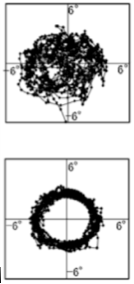
Eye-movement tracked while watching the stimuli. (top representing right rings, bottom representing left)
Left-hand rotating rings with painted-on spots were parsed as a solid figure of eight. Observers could easily track rigid intersection (lower right graph) (Anstis & Ito, Perception 2011).
Right-hand rotating rings with vertically aligned gaps or spots appeared to slide. Observers could not track sliding intersection where rings cross. Upper right-hand graph shows the noisy pattern of eye movements.
No flies on Rama: The flying bugs illusion
These two bugs fly clockwise along circular orbits of the same size, in all 3 movies. They are in counter phase; one is at 6 o’clock when the other is at 12 o’clock.
Now the right orbit looks twice as big as the left orbit, because the clockwise moving background is in phase with the left-hand orbit but in counter-phase with the right-hand orbit, which it enhances.
The orbits look elliptical, wide on the left and tall on the right.The background moves counter-clockwise and is in counter-phase with the horizontal components of the left fly but the vertical components of the right fly.
Flash-Grab
With PATRICK CAVANAGH
Motion undershoot. Bar rotates through 180°, from 12 to 12 o’clock. But it appears to move only from 1 to 11 o’clock.
Same as the ring but for linear motion. Red and green bars are in the same position but appear to be offset. Try tracking them with your eyes; your eyes feel as if they move, but they really don’t!!
Same idea here! Right-angled cross looks wonky because moving sector edges shift the cross arms more than moving middles of sectors.
Local and Global Motion with Juno Kim
At first, this ambiguous motion stimulus looks like four pairs  of dots, each rotating about their common center, but after a while it perceptually reorganizes into two large squares (with a dot at each corner) floating over each other. These local and global forms of “common fate” often alternate; on a 30s trial, local motion is usually seen first, followed by global motion. And across a series of trials, global motion is gradually seen more often. This suggests two adaptation (or learning) processes with different time constants.
Above: These cubes are readily organised perceptually into two large squares
Conversely, the lovers gazing into each other’s eyes are seen not as a large female square and large male square but as locally moving pairs.
Each pair of spots is phase shifted by 45 degrees from its neighbors. The blue circles tend to constrain the pairs to remain local
Without the circles, one perceives two intertwined global octagons.
Color Afterimages


with ROB VAN LIER and MARK VERGEER
Gaze steadily at the cross, ALWAYS! Without moving your eyes, note the colors of the squares (red, green, blue, yellow). Every so often, different colors will flash up briefly. These colors are afterimages–not on the screen, but in your head!
The adapting plaid, below, consists of a blue/yellow vertical grating, superimposed on a red/cyan horizontal grating. After adapting to this plaid, vertical black test lines make the afterimage look yellow/blue, while horizontal test lines make the after image look cyan/pink. Thus one and the same adapting pattern gives differently colored afterimages.
Conclusion: the visual system averages after image colors within but not across luminance test contours.
Below, second-order test stripes defined only by motion give the same BY and RC afterimages. These are not first-order test contours defined by luminance, but are second-order contours defined only by motion. But the horizontal bars still look blue/yellow and the vertical bars look red/green.
Above: The “+” test field looks red and green, while the “Tic-Tac-Toe” test field looks blue and yellow. All from one and the same adapting field.